


The Contribution of
the "Off-stage" Concept
to Storytelling:
An Analysis Through Rukeyser’s “Myth”
In storytelling, exploring the unseen dimensions of a narrative serves as a powerful tool for enriching its depth and complexity.
Theatre scholar Prof. Beliz Güçbilmez offers a compelling lens for this exploration through her concept of the “offstage.” She argues that in playwriting, “offstage” is not a real place but an idea—a world minus a stage. It is “anywhere but here,” and its time is time-minus-now, making it impossible to determine its scale. It is a foreign tongue—a language with an unknown grammar that carries us to the borders of the uncanny.
Hidden Layers in Narratives
This framework allows storytellers to delve into the concealed aspects of their narratives and explore the inner worlds of their characters more deeply.
Muriel Rukeyser’s poem Myth vividly illustrates the practical application of this concept:
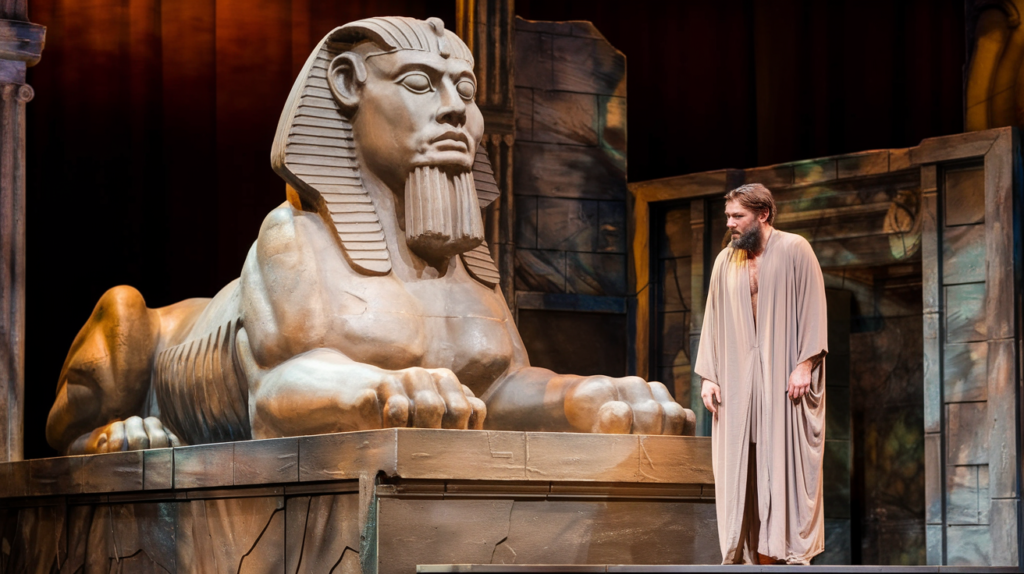
Long afterward, Oedipus, old and blinded, walked the roads.
He smelled a familiar smell.
It was the Sphinx.
Oedipus said, “I want to ask one question. Why didn’t I recognize my mother?”
“You gave the wrong answer,” said the Sphinx.
“But that was what made everything possible,” said Oedipus.
“No,” she said. “When I asked, what walks on four legs in the morning, two at noon, and three in the evening, you answered, Man. You didn’t say anything about woman.”
“When you say Man,” said Oedipus, “you include women too. Everyone knows that.”
She said, “That’s what you think.”
Rukeyser’s Transformative Approach to Myth
Did you notice what Rukeyser does with this poem? She doesn’t merely rewrite the Oedipus myth; she transforms a piece of information into a scene. In Sophocles’ tragedy, we only hear that Oedipus once solved the Sphinx’s riddle—it is mentioned offstage. It happens there, unseen. We never witness it as a scene.
This is a crucial distinction. In narrative terms, the original moment is diegetic—told, not shown. However, Rukeyser recreates this unseen moment mimetically. She stages not the first, but a fictional second encounter between Oedipus and the Sphinx, generating a future from the myth’s past.
Additionally, she introduces a potent gender critique. Rukeyser revisits the act of naming “woman,” challenging assumptions embedded in classical myths. By giving voice to the Sphinx—a figure usually silenced or peripheral—she invites us to reconsider gender, knowledge, and exclusion in storytelling.
A Source of Creative Potential
This act of re-seeing the myth becomes a limitless source for writing. At Magnetic Field Method, we emphasize that writing is always rewriting—and that is where its value lies. No fictional piece has ever been purely original. All stories are layered with echoes of others.
Consider, for instance, how Tom Stoppard’s Rosencrantz and Guildenstern Are Dead reimagines Hamlet through the eyes of two minor characters. It exemplifies how the “offstage” can be brought to center stage, fundamentally reshaping our understanding of a familiar narrative. This technique adds depth to the original while opening space for new interpretations.
Rethinking the Structure of Storytelling
The “offstage” concept ultimately encourages storytellers to think differently. It becomes a method for examining the forces and moments that drive a narrative but remain unseen. These unseen moments—like motives, silences, or lost voices—can reveal essential truths about characters and story worlds.
Furthermore, using this approach reshapes not only individual works but also broadens the landscape of narrative techniques. Writers become free to explore what lies just outside the spotlight.
For those developing their own fiction, our online video lessons offer guided steps to applying such concepts practically.
To further explore how these elements impact the magnetic structure of fiction, our Cathedral Episode offers a vivid case study in action.


No Responses